Fr
Fr en
en de
de
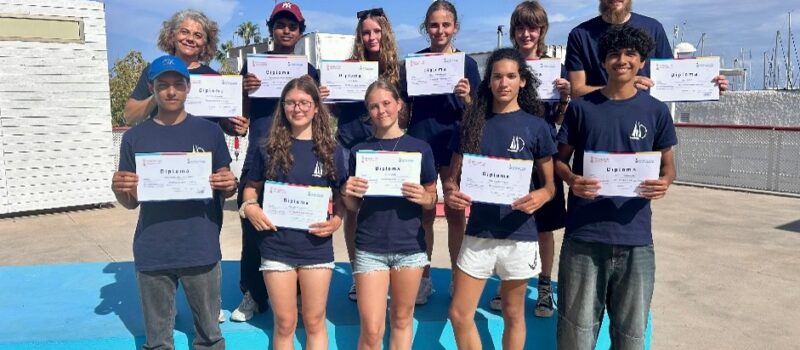
As has been tradition at the European School Karlsruhe for the last years, nine students and two teachers travelled to the Escola de la Mar in Borriana, Spain, to participate in this year’s Erasmus Maris Week. This project is a scientific force fighting the pollution of microplastics in bodies of water through the establishment of a continent-wide data net, accessible to researchers, and provided for by students. Since its establishment, Erasmus Maris continually develops and grows, with more schools joining annually.
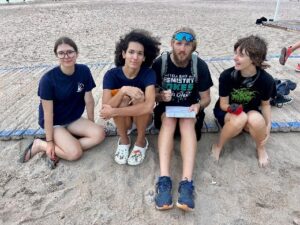
This year, S6 students Aarin, Alissa, Aniruddh, Clara, Devcharan, Isabel, Kay, Kira and Maude and teachers Mrs. Dreusch and Mr. Salm flew to Valencia Sunday, the 13th of September and returned on Friday, the 18th in the evening.
At the Escola de la Mar participants were split into groups for the nautical activities, but meals and lectures were attended by all.
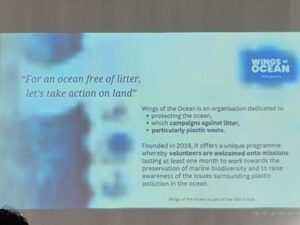
The program started immediately on Monday morning with a meeting, in which the history and goals of Erasmus Maris were explained to all participants and Wings of the Ocean presented their organization.
Following the lecture, the ESK group went kayaking for three hours. After lunch, all groups joined in the cafeteria to work on the research presentations: European Schools of Mol, Karlsruhe and Frankfurt were to present their shared research aim together and were thus given time to discuss and plan everything. Students from different schools mingled and worked together, dissecting the research aim and analysing the results to form a shared conclusion and cohesive report.
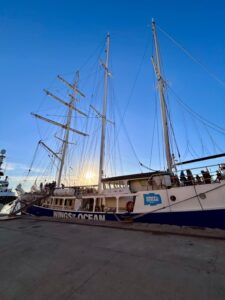
Finally, students visited “The Kraken”, the repurposed sailboat used by the Wings of the Ocean nonprofit organization.
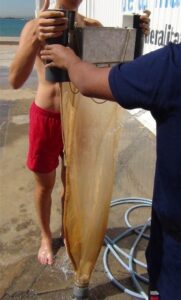
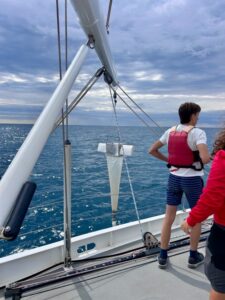
On Tuesday, the ESK group completed another nautical activity, the Dragon boat, in which students rowed together, before going sampling with the Manta Net on motorboats. The boats drove out to sea for a few minutes, before turning and slowly driving back, leaving the net in the water for 20 minutes during the return trip. Once the samples were collected, the Manta Net was washed, and the samples were prepared and treated with bleach overnight to digest any organic matter present.
Students were then given time to complete the mandatory online course of the Intergovernmental Oceanographic Commission of UNESCO (IOC) on Microplastic and Sampling Methods to earn their certificate, and a lecture with demonstration on the behaviour of different types of plastics in water bodies was given.
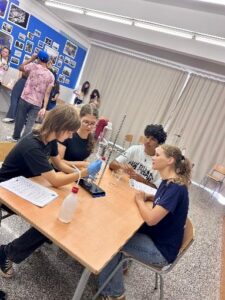
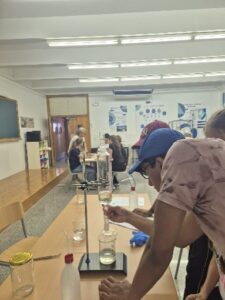
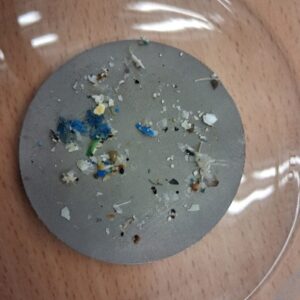
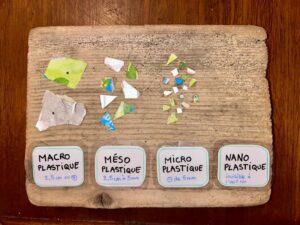
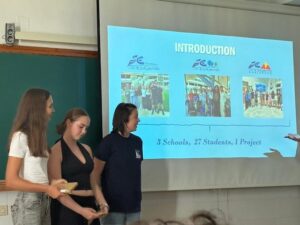
On Wednesday, the samples from the previous day were collected to be analysed in the laboratory. Following the provided protocol, the microplastic was collected on a metallic filter and counted.In the afternoon, students first attended a lecture held by Prof. Carlos Sanz-Lázaro of the University of Alicante on his work on Bioplastic, before presenting their findings in the much-awaited Research Report.After the presentations all Erasmus Maris participants, Wings of the Ocean and members of the Bioplastic lab headed to the beach to collect and classify litter, following the protocol developed by Bioplastic.
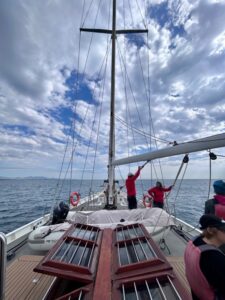
On Thursday, groups participated in a final nautical activity, sailing on the Tirant and sampling once more with the manta net. Afterwards, a competition was held by the Bioplastic lab in which students had to complete a quiz: Isabel of the ESK won the 1st prize!
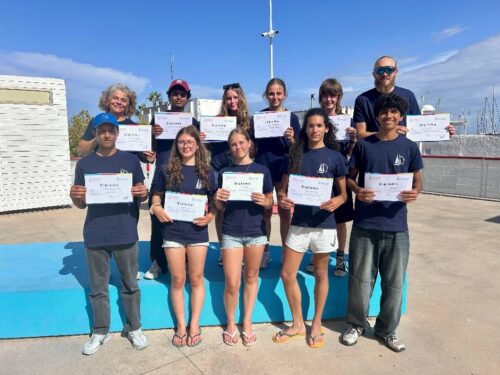
In the afternoon, certificates were handed out in a closing ceremony, the awards for the competition were given out, and the Erasmus Maris Week 2026 ended.
On Friday morning, all the groups left Escola de la Mar on two large buses. The ESK group had the chance to explore Valencia’s city centre before taking the subway to the airport. It was a fun and enriching experience for everyone!
by Isabel Ulusoy